
Table of Contents
- Why Textured Floral Art Works in a Minimalist Home
- How to Choose Modern Floral Wall Art for Your Space
- Minimalist Interior Design Art Placement: Where to Hang It
- Scale and Proportion: Sizing Your Textured Florals
- Lighting That Brings Out Depth and Shadow
- How to Hang Textured Art Without Damaging It
- Caring for Your Textured Canvas Painting
- Conclusion: Build Your Calm, Curated Corner
- Frequently Asked Questions
Last Updated: September 8, 2026
Textured floral art is the quiet rebellion your minimalist home has been waiting for. Where a stark white wall can feel cold and unfinished, a canvas with raised petals and sculpted surfaces introduces warmth without breaking the clean lines you’ve worked hard to achieve. At Emma Bell Fine Art, we understand this balance: the secret isn’t adding more, it’s choosing one piece with enough tactile presence to hold an entire room. Below, we’ll show you how to style these works so they enhance your minimalist interior design art placement.
Why Textured Floral Art Works in a Minimalist Home
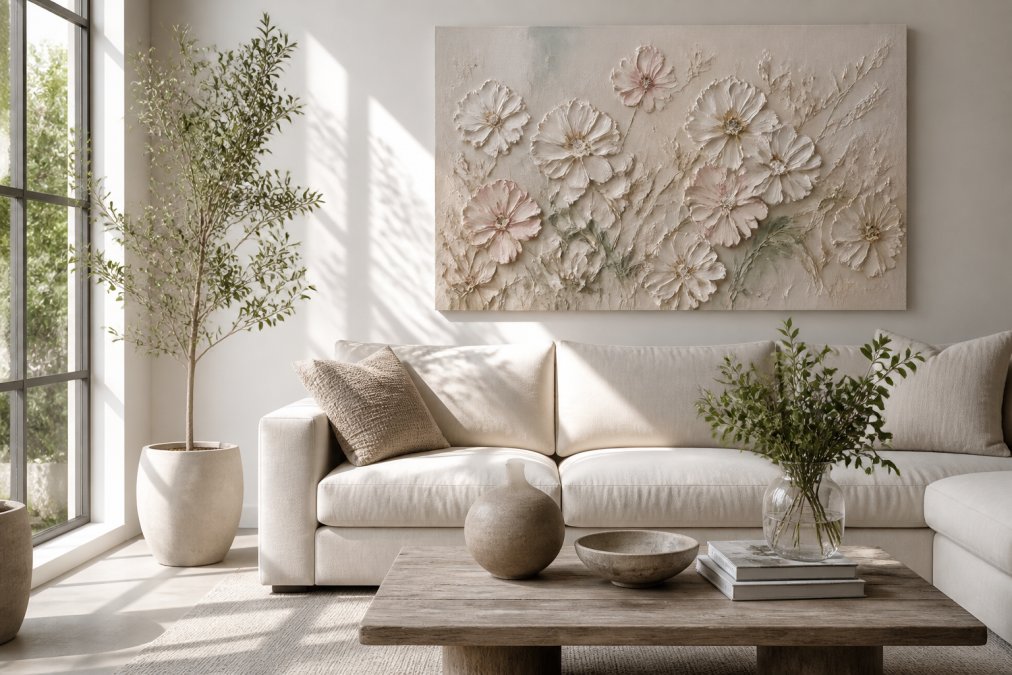
Minimalist spaces thrive on contrast, and nothing delivers contrast like a surface you can almost feel from across the room. A textured canvas painting adds depth and shadow that shifts with the light, giving a neutral palette a focal point without clutter.
The magic lies in the material. Plaster art, impasto florals, and gold leaf accents bring a handcrafted quality that mass-produced prints cannot match. These pieces act as sculptural objects, providing the tactile dimension a room of smooth surfaces and muted colors needs.
How to Choose Modern Floral Wall Art for Your Space
Choosing modern floral wall art for a minimalist home comes down to one rule: tonal restraint. If your space leans on earthy tones, seek out canvases with muted sage, clay, or sand. If you prefer a crisp, monochrome look, a white-on-white plaster bloom or a piece with subtle silver leaf will disappear and reappear as the light moves.

Avoid anything overly literal. The most successful contemporary botanical pieces for minimalist settings are abstracted, where the flower is suggested through layered paints and sculpted surfaces rather than depicted in perfect detail. Texture paste and palette knife work create a visual rhythm that echoes nature without shouting about it.
Minimalist Interior Design Art Placement: Where to Hang It
Placement is where most people stumble, hanging a piece wherever there is an empty wall. In a minimalist home, every placement decision affects spatial balance, so you need a strategy.
Living Room Placement
In the living room, the textured floral art should relate to the seating, not the television. Hang it above a sofa or console where it can act as the room’s focal point, with the canvas center at eye level, roughly 57 to 60 inches from the floor, the standard gallery height (si.edu).
Bedroom Placement
The bedroom calls for a softer approach. Position the canvas above the headboard, centered, and allow it to be the last thing you see before sleep. A piece with muted colors and gentle depth works best here.
Scale and Proportion: Sizing Your Textured Florals
The most common mistake is buying art too small for the wall. A tiny canvas floating on a large wall undermines the calm you are trying to create. As a rule, the artwork width should be roughly two-thirds to three-quarters the width of the furniture beneath it.
For a standard queen bed, a 40x40 inch piece like the Hydrangea Haze Abstract feels substantial and balanced. For a large living room wall above a 90-inch sofa, you have room to go bigger, with a 48x48 inch statement piece such as the Lilly Field Abstract commanding the space. When in doubt, err on the side of larger; textured art reads best when it has room to breathe.

| Furniture Width | Recommended Canvas Size | Best For |
|---|---|---|
| 60-72 inches (loveseat) | 24x24 to 36x36 | Bedrooms, small living rooms |
| 72-90 inches (standard sofa) | 36x36 to 40x40 | Main living areas |
| 90+ inches (oversized sofa) | 48x48 or larger | Open-plan spaces, grand walls |
| Above a headboard | 36x36 to 40x40 | Primary bedrooms |
Lighting That Brings Out Depth and Shadow
Lighting is the single most underrated tool in your minimalist styling arsenal. A textured floral piece only reveals its full character when light hits it at the right angle. Flat, diffuse overhead lighting will flatten the impasto ridges and plaster petals into a muted, shadowless surface. To make the texture sing, control the direction, angle, and color temperature of your light.
The Physics of Raking Light
The key mechanism is "raking light", light striking a surface at a low, oblique angle, typically 15 to 30 degrees from the wall plane. At this angle, the raised peaks cast elongated shadows onto the recessed valleys, creating the perception of depth. A light source at 45 degrees or steeper produces shorter shadows, effectively flattening the piece.
For a wall-mounted canvas, use a dedicated picture light mounted 6 to 12 inches above the frame, angled downward, with an adjustable swivel head. A 20-degree beam spread is ideal for a 40x40 inch canvas, covering the entire surface without spilling excessive light onto the surrounding wall.
Smart Home Integration for Dynamic Texture
With a smart home system, you can program lighting scenes that change the character of the art throughout the day, mimicking the natural progression of sunlight to keep the piece feeling alive.
- Morning Scene (6:00 AM - 10:00 AM): Use a cool white (4000K) directional spotlight at a 30-degree angle from the left. This casts crisp, defined shadows that emphasize the sharpest peaks of the texture, ideal for a fresh, alert start to the day.
- Afternoon Scene (10:00 AM - 4:00 PM): Dim the spotlight to 60% intensity and switch to a neutral white (3500K). This softens the shadows and allows the color palette of the florals to take center stage.
- Evening Scene (4:00 PM - 11:00 PM): Switch to a warm white (2700K) and lower the angle to 20 degrees from the right. The warmer temperature and longer shadows create a dramatic, intimate atmosphere that complements evening relaxation. This is the scene that will make the gold leaf or subtle metallic accents in your piece flicker and glow.
Hardware and Placement Mechanics
For a truly minimalist look, the light source should be invisible. Recessed adjustable gimbal lights in the ceiling are the gold standard. If using a surface-mounted track system, position the track at least 24 inches from the wall and aim the heads at the art.
If using a plug-in picture light, manage the cord cleanly. Use paintable cord covers that match your wall color, or have a licensed electrician install a dedicated outlet behind the art piece so no cord is visible.
Color Temperature and CRI
Pay attention to the Color Rendering Index (CRI) of your bulbs. A CRI of 90 or above is essential for art; low-CRI bulbs will make the subtle blush tones and sage greens look muddy and desaturated (energy.gov). Most reputable brands list CRI on the packaging, this is not a spec to compromise on.
How to Hang Textured Art Without Damaging It
Textured canvases are heavier than they look, especially gallery wrap pieces with deep 1.5-inch profiles. Standard picture hooks often fail under the weight. Use hardware rated for at least double the weight of the piece.
For most original paintings, a heavy-duty drywall anchor with a screw rated for 30 to 50 pounds is sufficient. If you are hanging on plaster or lathe walls, which are common in older homes, use a masonry bit and a toggle bolt instead. Always locate the wall studs first with a stud finder; if you can drive a screw directly into a stud, that is the most secure option available. For large 48x48 canvases, use two D-rings spaced a third of the way down from the top edge, and ensure the wire or brackets are rated for the weight.
Caring for Your Textured Canvas Painting
A textured canvas is a living object with specific maintenance needs. The raised impasto and plaster surfaces are more vulnerable than a flat print, and the way you clean them matters.
The Dusting Protocol
The primary enemy of textured art is dust accumulation in the crevices of the texture. Dust settles into the valleys between the raised petals and, over time, binds with ambient moisture to form a film that dulls the surface. Dust frequently enough that you never need a wet cleaner.
- Frequency: Dust every 2 to 4 weeks. If you live in a dusty environment, have pets, or run a forced-air HVAC system, err on the side of every 2 weeks.
- Tools: Use a soft, natural-bristle brush (a wide makeup brush or a dedicated art brush with goat or badger hair) or a microfiber duster with a long, soft pile. Avoid synthetic bristles that can be too stiff and catch on the raised edges of the texture.
- Mechanism: Hold the brush at a 45-degree angle and use light, sweeping strokes that follow the direction of the texture. For example, if the impasto strokes flow upward, dust from the bottom to the top. This prevents pushing dust deeper into the crevices. Do not press down; you are lifting dust, not scrubbing the surface.
Material-Specific Care
Different textures require different protocols. Here is how to handle the three most common mediums in textured floral art:
Plaster and Texture Paste: These are the most fragile. Plaster is essentially a hardened mineral paste, and it can chip or crack if struck. Never use a vacuum cleaner, even with a brush attachment, the suction is too strong and can pull loose particles. For stubborn dust in deep crevices, use a can of compressed air (the kind used for electronics) held at least 6 inches away, using short bursts. Do not use liquid cleaners of any kind; moisture will soften the plaster and compromise its structure.
Impasto Oil or Acrylic: These are more resilient than plaster but still vulnerable to pressure. The paint is essentially a thick, cured plastic or oil film. You can use a slightly damp (not wet) microfiber cloth for spot cleaning, but only if the piece has a varnish layer. Unvarnished acrylic can be porous. If you are unsure whether your piece is varnished, stick to dry dusting only. A common pattern among collectors is to apply a conservation-grade varnish every 5 to 7 years to protect the surface and make future cleaning easier.
Gold Leaf or Metallic Accents: These are the most delicate. Gold leaf is measured in microns and can be scratched by even a soft brush if you are not careful. For pieces with metallic accents, use a dry, ultra-soft sable brush and work in one direction only, never back and forth. Do not use any cleaning solution on gold leaf; the adhesive beneath can dissolve.
Environmental Controls
Your home's climate is a silent factor in the longevity of your art. Canvas expands and contracts with humidity, and rapid swings can lead to cracking in the texture paste or paint layers.
- Humidity Range: In dry winter months, a humidifier in the room can prevent the canvas from becoming brittle (nga.gov). In humid summer months, a dehumidifier or air conditioning will prevent the canvas from sagging.
- Temperature: Keep the room between 65°F and 75°F. Avoid placing the art near heat vents, radiators, or fireplaces, as the direct heat will accelerate the drying and cracking of the paint medium.
- Sunlight: Direct, harsh sunlight is the enemy of pigment. UV rays will fade the colors over time, and the heat will accelerate the expansion-contraction cycle. If the piece must be in a room with direct sun, install UV-filtering window film. This is a low-cost, invisible solution that blocks up to 99% of UV rays without changing the light quality in the room.
The Annual Inspection
Once a year, take the piece down and inspect it in good light for hairline cracks, loose canvas, or flaking. If you see a crack, do not attempt to repair it yourself, a professional art conservator can stabilize it. Catching a small issue early prevents costly restoration later. Also check the hanging hardware.
Conclusion: Build Your Calm, Curated Corner
Styling textured floral art in minimalist homes is about restraint and intention. You are not filling a wall; you are creating a sanctuary. A single, thoughtfully chosen piece with sculpted surfaces and a tonal palette can transform a stark room into a serene home.
At Emma Bell Fine Art, every original painting is created with palette knife and mixed media techniques, built up in layers to capture the fleeting beauty of nature. Whether you are drawn to the bold presence of the Beautiful Blush Hydrangeas or the softer scale of the Spring Blossom Abstract, each canvas is designed to bring color, dimension, and joy into your space.
Frequently Asked Questions
What floral design embraces minimalism?
Look for paintings with a tonal palette: muted colors, earthy tones, and neutral shades like blush, sage, or cream. A single stem or a loose cluster of blooms on a textured canvas offers visual interest without the visual noise of a busy, multi-colored bouquet. The texture of the palette knife work provides the tactile dimension that keeps the piece feeling contemporary and sculptural.
How do you style textured wall art without cluttering a minimalist space?
Let the painting be the focal point. Hang it on a wall with no other competing decor, and keep surrounding furniture simple and low-profile. A single large piece creates more impact than a gallery wall. Use the 2/3 rule for sizing: the artwork should take up about two-thirds of the width of the furniture beneath it. This maintains spatial balance and visual rhythm.
What lighting best highlights textured floral paintings?
Directional lighting, such as a picture light mounted on the frame or a ceiling track light, creates depth and shadow across the raised petals and sculpted surfaces. Angle the light to graze the canvas from above or the side. This technique emphasizes the impasto texture, making the modern floral wall art feel more dynamic as the light changes throughout the day.
How do you choose the right size floral art for a minimalist room?
Measure your wall and the furniture below it. For a living room, a 48x48 canvas like the Lilly Field Abstract works well above a large sofa. For a smaller bedroom or entryway, a 36x36 piece like Spring Blossom Abstract provides a quieter focal point. The art should never feel lost on the wall, nor should it overwhelm the space.
Finding the perfect textured floral art for your minimalist home starts with understanding how scale, light, and placement work together. The original collection at Emma Bell Fine Art offers museum-quality gallery wrap canvases with the deep texture your walls are waiting for. Get started with Emma Bell Fine Art and find the piece that turns your calm, curated corner into the heart of your home.