
Table of Contents
- Why Textured Canvas Art Needs Different Hanging Hardware
- Tools and Materials You'll Need Before You Start
- Step 1: Measure and Mark Your Wall Placement
- Best Hardware for Canvas Art by Weight and Wall Type
- How to Level Canvas Art for a Professional Finish
- Renter-Friendly Wall Art Hanging Methods That Protect Walls
- Choosing Hanging Methods for Textured Surfaces and Wall Variations
- Common Mistakes to Avoid When Hanging Textured Canvas Art
- Frequently Asked Questions
Last Updated: September 17, 2026
Why Textured Canvas Art Needs Different Hanging Hardware
A palette knife painting carries weight that a flat print never will. Thick acrylic layers, a 1.5-inch gallery wrap, and a rigid canvas frame add up fast, and standard sawtooth hangers simply are not built for that load. This guide from Emma Bell Fine Art covers the best ways to hang textured canvas art so a heavy, dimensional piece stays level, secure, and undamaged.
Most hardware sold in picture-hanging kits is rated for lightweight frames. A textured original is a different animal. The canvas frame itself is deeper, the surface is uneven, and the weight sits farther from the wall. Get the hardware wrong and the piece sags, tilts, or pulls free.
Tools and Materials You'll Need Before You Start
Gather everything before you touch the wall. A level, a tape measure, a pencil, a stud finder, and the correct mounting hardware for your canvas weight and wall type will cover most installations. Add a screwdriver, a small hammer, and painter's tape for marking.
Here is what belongs in your kit:
- Tape measure and carpenter's level (a 24-inch level beats a phone app for accuracy)
- Stud finder with a live-wire alert
- Pencil and painter's tape for marking without damaging paint
- Mounting hardware matched to weight: D-rings, picture wire, French cleats, or wall anchors
- Screwdriver, drill, and a stud bit
- Adhesive strips if you are renting and the piece is light
Step 1: Measure and Mark Your Wall Placement
Placement starts with the center point. Measure the width of the canvas, divide by two, and mark the wall's horizontal center. For vertical position, most galleries hang art with the center of the piece at roughly eye level, around 57 to 60 inches from the floor.
Mark the canvas's top edge first, then work downward. Hold the piece against the wall with painter's tape to check the look before you commit to a hole.
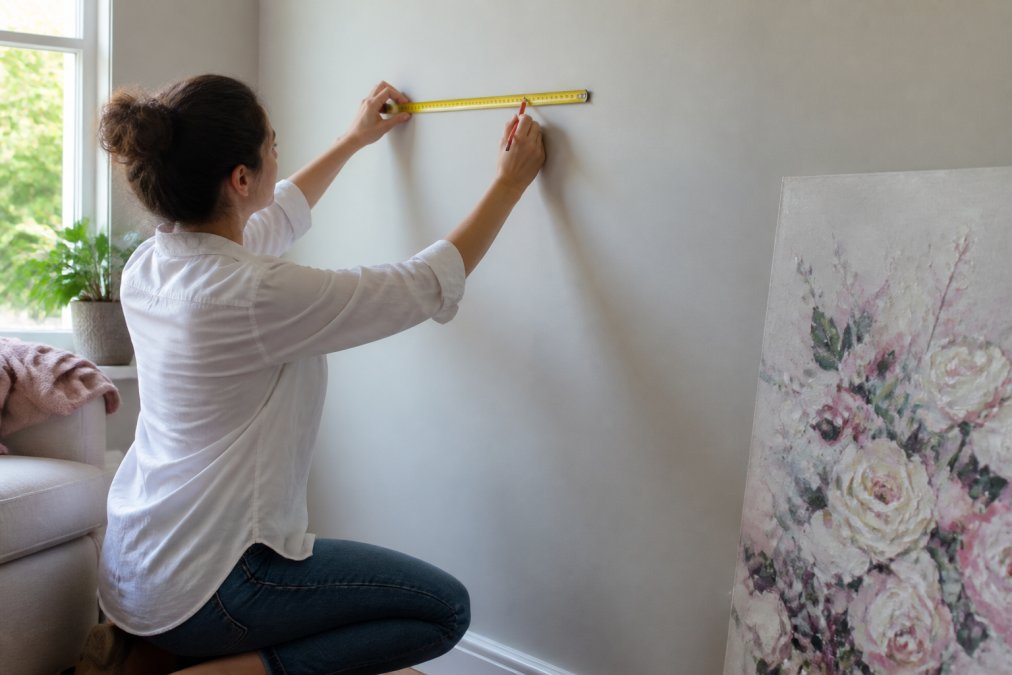
Double-check vertical alignment with the level before drilling. A wall anchor hole is permanent; a pencil mark is not.
Best Hardware for Canvas Art by Weight and Wall Type
The best hardware for canvas art depends on two things: how heavy the piece is and what the wall is made of. Match the mount to the load, and the installation will hold for years. The table below pairs common canvas sizes with approximate weights and the hardware that reliably carries them.
| Canvas Size | Approx. Weight | Recommended Hardware | Wall Type |
|---|---|---|---|
| Up to 16x20 in | 2-5 lbs | Sawtooth hanger or adhesive strips rated for the load | Drywall or plaster |
| 24x30 in | 5-12 lbs | Two D-rings with #14 or heavier picture wire | Drywall with toggle anchors |
| 30x40 in | 12-25 lbs | Two D-rings with heavy-duty wire, or a 6-inch French cleat | Studs or toggle anchors |
| 40x48 in and up | 25 lbs and up | French cleat into studs (8-inch or longer) | Studs required |
Weights vary with frame depth, canvas thickness, and how heavily the artist applied paint. A palette-knife piece with thick impasto can run heavier than a flat acrylic of the same dimensions.
D-Rings and Picture Wire for Heavy Canvas
D-rings screw into the canvas frame and distribute weight evenly across the back. Attach two D-rings at the same height on each side, roughly one-third of the way down from the top edge. Run picture wire between them with a slight upward tension so the wire sits just below the top edge when hung.
French Cleats and Wall Anchors for Large Pieces
A French cleat is the most secure option for large canvases. One interlocking bracket mounts to the wall, the other to the canvas frame, and the two lock together for a flush mount. Cleats are sold in lengths; a cleat should span at least half the width of the canvas to spread the load.
Matching Hardware to the Actual Load
Hardware packaging lists a working load limit, and that number is the ceiling, not the target. A safe installation keeps the load at roughly half the rated capacity. If a toggle anchor is rated for 50 lbs in drywall, plan for no more than about 25 lbs of canvas on it. This margin absorbs vibration, humidity swings, and the occasional bump.
How to Level Canvas Art for a Professional Finish
Leveling is where most DIY hangs go wrong. Even a small tilt is visible on a large piece, and textured surfaces make it harder to judge by eye.
Follow this sequence:
- Mark the center point and the top-edge height.
- Measure the distance from the wire's peak to the top of the canvas frame.
- Transfer that distance down from your top-edge mark to locate the hook.
- Install the hook, then hang the piece and check with a level.
- Adjust the wire or hook height in small increments until level.
Renter-Friendly Wall Art Hanging Methods That Protect Walls
Renter-friendly wall art hanging methods let you display work without leaving large holes. Adhesive strips and removable hooks work well for lighter canvases and flat walls. They are not the right choice for a heavy textured original, which needs load-bearing hardware.
Choosing Hanging Methods for Textured Surfaces and Wall Variations
Wall type changes everything. Drywall, plaster, brick, and paneled surfaces each demand different hardware, and textured walls add a layer of difficulty because the surface is not flat. Just as important, the canvas itself has a textured face that can be damaged during installation if you handle it carelessly.
- Drywall: Use toggle anchors or find a stud. Standard plastic anchors pull out under heavy loads.
- Plaster: Plaster is brittle and cracks easily. Drill slowly, use a masonry bit, and lean on toggle anchors.
- Brick or stone: Use masonry anchors and a hammer drill. A French cleat works well here.
- Textured walls: The uneven surface can prevent a flush mount. A French cleat bridges the gap and keeps the canvas sitting straight.
Protecting the Textured Canvas Surface During Installation
A palette-knife painting has ridges, peaks, and raised edges that chip or flatten if you press on them. Before you lift the piece, put on clean cotton gloves. Oils from bare hands can dull a matte finish and leave marks that are hard to remove.
Bridging Uneven Walls for a Flush Mount
On a textured wall, the canvas can rock against high spots and leave gaps at the corners. A French cleat solves this by holding the frame off the wall at a consistent depth. Add small felt or rubber bumpers to the back corners so the canvas rests evenly and does not scuff the wall.
Wall-by-Wall Hardware Notes
On drywall, a toggle anchor rated for 50 lbs is a common choice for medium canvases. On plaster, drill at low speed to avoid cracking the skim coat, and back the bit out often to clear dust. On brick or stone, a hammer drill and masonry bit are required; a standard bit will not cut the surface. On paneled walls, find the stud behind the paneling or use a toggle anchor that can grip the panel thickness.
Common Mistakes to Avoid When Hanging Textured Canvas Art
The most frequent mistake is under-mounting. People match hardware to the frame size, not the actual weight, and a heavy canvas pulls free over time.
Other errors to watch for:
- Hanging from a single point instead of two, which causes tilting and stress on the frame
- Skipping the stud finder and drilling blind
- Using wire rated below the canvas weight
- Ignoring vertical alignment and eyeballing the height
- Placing adhesive strips on textured or freshly painted walls
Frequently Asked Questions
What is the best way to hang canvas art on the wall?
For textured canvas art, the best method depends on weight. Small pieces under 10 pounds work well with sawtooth hangers or adhesive strips. Medium pieces from 10 to 25 pounds need D-rings and picture wire attached to wall anchors. Large or heavy canvases over 25 pounds, like a 48x36 original painting, should use a French cleat or heavy-duty drywall toggle anchors. Always attach hardware to the canvas frame itself, never to the stretched fabric.
What are some renter-friendly ways to hang canvas art?
Renter-friendly wall art hanging methods include adhesive strips rated for the canvas weight, removable plastic hooks, and tension rods for shelving. For heavier textured pieces, adhesive strips work if you use enough of them. Always follow the weight limits on the packaging and remove them slowly to protect wall integrity.
Should I use wire or D-rings for textured canvas art?
D-rings installed on the canvas frame with picture wire strung between them is the standard for medium to heavy textured canvas art. D-rings screw directly into the wooden stretcher bars, providing load-bearing support. The wire should have a tension that creates a shallow V shape when hung. For very heavy pieces, skip the wire and mount D-rings directly onto wall anchors or use a French cleat for even weight distribution.
How do you hang heavy textured canvas art securely?
Hang heavy textured canvas art by locating wall studs with a stud finder and driving screws directly into them. If studs are not available, use drywall toggle anchors rated for twice the canvas weight. Attach a French cleat to both the wall and the canvas frame for pieces over 40 pounds. This distributes weight evenly and keeps the canvas flush mount against the wall. Test the anchor by pulling firmly before hanging your art.